
Question types
Razzia has three question types, set with the type field of each question. When type is omitted, the question is a single-answer one.
| Type | Players… | Scored on |
|---|---|---|
single |
pick exactly one answer | being right, and how fast |
multi |
pick one or more answers | the right picks, and how fast |
estimation |
give a number | how close they get |
Single answer
Section titled “Single answer”The default type. Players pick one answer among 2 to 4, and solutions holds the index of the right one:
{ "question": "What is the capital of France?", "answers": ["Berlin", "Paris", "Madrid", "Rome"], "solutions": [1], "cooldown": 5, "time": 15}A right answer earns up to maxPoints (1000 by default). The faster the answer, the more points it earns. See Speed and points.
Multiple answers
Section titled “Multiple answers”With "type": "multi", players can pick several answers, and solutions lists every right one:
{ "type": "multi", "question": "Which of these are primary colors?", "answers": ["Red", "Green", "Blue", "Yellow"], "solutions": [0, 2, 3], "options": { "scoringMode": "balanced" }, "cooldown": 5, "time": 20}options.scoringMode decides how a partly right selection is scored:
| Mode | How it scores |
|---|---|
strict |
Full points only if the selection matches the solutions exactly, nothing otherwise. |
balanced |
Each right pick earns its share of the points, and each wrong pick cancels one right pick. This is the default. |
lenient |
Each right pick earns its share of the points, and wrong picks cost nothing. |
For example, with three right answers out of four and a player who picks two right answers and one wrong one:
strictgives no points, because the selection isn’t exact.balancedgives a third of the points: two right picks minus one wrong pick, out of three.lenientgives two thirds of the points: two right picks out of three.
Estimation
Section titled “Estimation”An estimation question asks for a number instead of offering answers, like “How many days does a fly live?”. Players answer with a slider or by typing a number, and they are scored on how close they get, not on how fast they answer.
In the editor, set the answer mode to Estimation, then set the bounds and the expected answer on the slider, and the input type, step and margin in the settings.
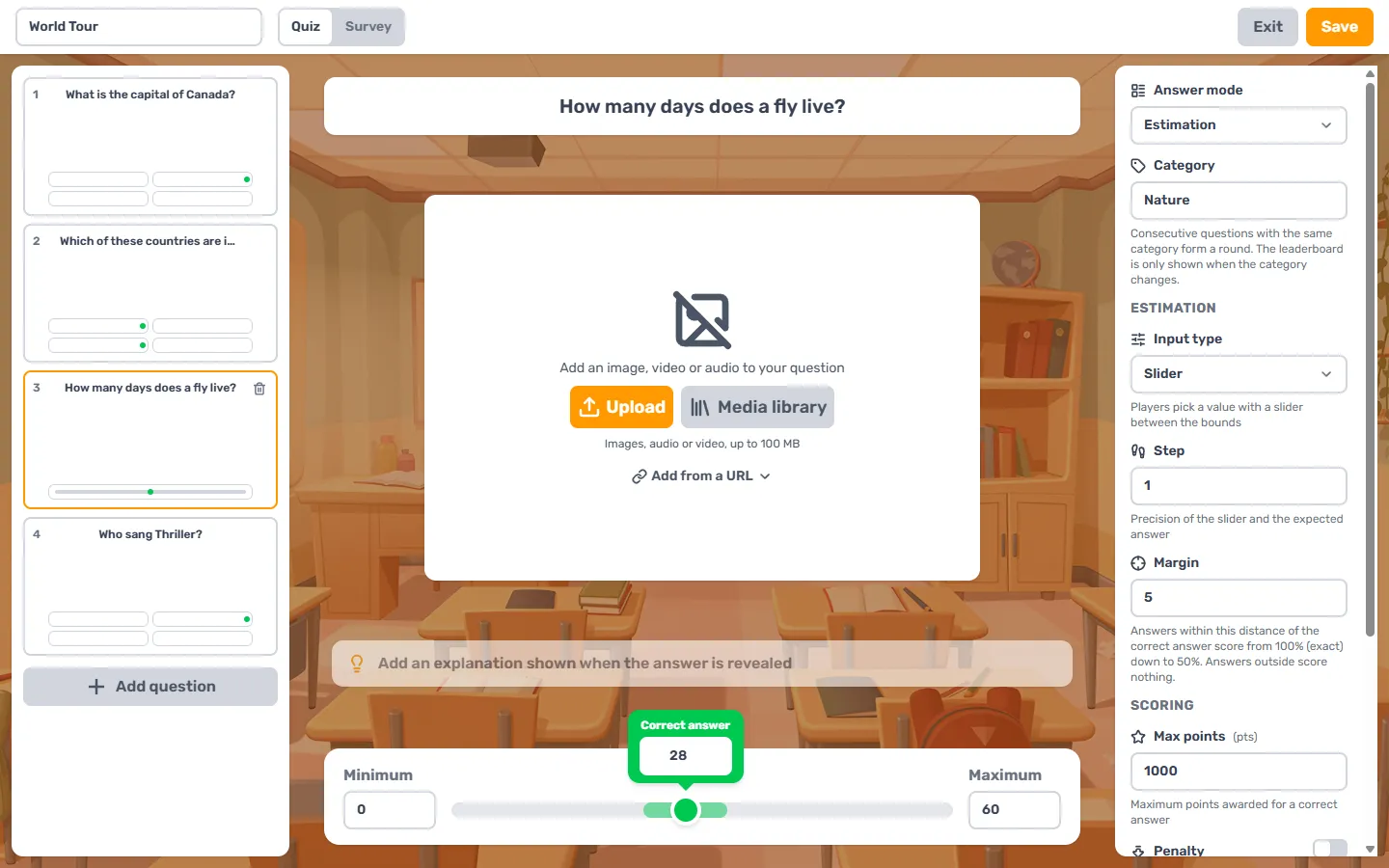
In JSON:
{ "type": "estimation", "question": "How many days does a fly live?", "answers": [], "solutions": [28], "options": { "inputMode": "slider", "min": 0, "max": 60, "step": 1, "margin": 5 }, "cooldown": 5, "time": 30}answersis always an empty array.solutionsholds a single value: the expected number, betweenminandmax.options.inputModeissliderto pick a value on a slider, orinputto type it.options.minandoptions.maxbound the accepted values.maxmust be greater thanmin.options.stepis the precision of the slider, and must be greater than0.options.marginis how far from the expected value an answer still counts as right.
The scoring follows the margin:
- An exact answer earns
maxPoints. - An answer at the edge of the margin earns half of it, and the points decrease steadily in between.
- An answer outside the margin earns nothing, and costs the
penaltyif one is set.
With a margin of 0, only the exact value counts.
Speed and points
Section titled “Speed and points”For single and multiple answer questions, speed matters. A player who answers right away can earn up to maxPoints, and the points drop steadily as the timer runs, down to 0 at the end of the answer time.
With "time": -1, the question has no time limit, and the points depend on the order of the answers instead: the first player to answer can earn maxPoints, the last one half of it.
Estimation questions ignore speed: only the distance to the expected value counts.
Points and penalties
Section titled “Points and penalties”Two fields tune the scoring of any question:
maxPoints: the most points a right answer can earn. Defaults to1000. Set it to0for a question that doesn’t count.penalty: the points a wrong answer costs. No penalty by default. A player’s total never goes below0, and a player who doesn’t answer loses nothing.
{ "question": "Bonus: what year did the Berlin Wall fall?", "answers": ["1987", "1989", "1991", "1993"], "solutions": [1], "maxPoints": 2000, "penalty": 500, "cooldown": 5, "time": 20}